Introduction: Why AI & Emotion Matter
As AI becomes embedded in everyday life—through chatbots, virtual assistants, and mental health apps—its ability to simulate emotional responses is more than a technological gimmick. It affects how humans perceive connection, trust, and even care. Throughout my digital essay, I want readers to ponder: Can machines truly “feel”? Does it matter if they can’t, as long as they act like they do? Why are we building machines that mimic human empathy in the first place?
Artificial empathy and AI systems can recognize, simulate, and respond to human emotions (Sahota). Artificial empathy—a growing, more practical, and widely studied concept—is crucial regarding AI. With AI increasingly integrated into various applications, social media, customer service, and mental health, artificial empathy’s social and emotional implications are vast and raise ethical, philosophical, and technological questions—the intersection of technology and human emotion (Sahota). Typically, when I think of AI and emotions, I often reflect on the various forms of media I have engaged with where the AI is deemed simple, yet it becomes destructive to a human’s life. I believe it is fundamental for individuals to rethink their definitions of empathy and intelligence.
Quick Video: A Deep Look into Artificial Intelligence
Created by author Julianna O’Brien, this video explores how AI systems simulate empathy by recognizing and responding to human emotions through sentiment analysis and emotion detection tools.
Core Terminology
In this section, I will define empathy, artificial empathy, and emotional intelligence and how they differ. I will also explain how artificial empathy works and its application in industries.
- Empathy
- The ability to understand and share the feelings of another person (Ryan).
- Example: When a friend is upset, you recognize their sadness, feel for them, and respond with care.
- Empathy involves cognitive (understanding) and affective (feeling) dimensions.

Visual Cue: AI-generated image using ChatGPT — Two people talking with a shared emotional bubble above their heads.
- Artificial Empathy
- The simulation of empathy by machines—AI systems that detect, interpret, and respond to human emotions (Sahota).
- Example: A mental health chatbot like Woebot recognizes a user’s sadness and offers a comforting message.
- Unlike human empathy, artificial empathy is performative, not felt—based on data and algorithms.

Visual Cue: AI-generated image using ChatGPT — A chatbot with a heart icon or facial recognition lines reacting to a person.
- Emotional Intelligence (EI)
- The capacity to be aware of, control, and express one’s emotions and to handle interpersonal relationships empathetically.
- Example: A leader who can sense when their team is stressed and responds supportively.
- EI is a human skill that AI attempts to replicate, but it usually only mimics parts of it (like emotion recognition, not emotional nuance).
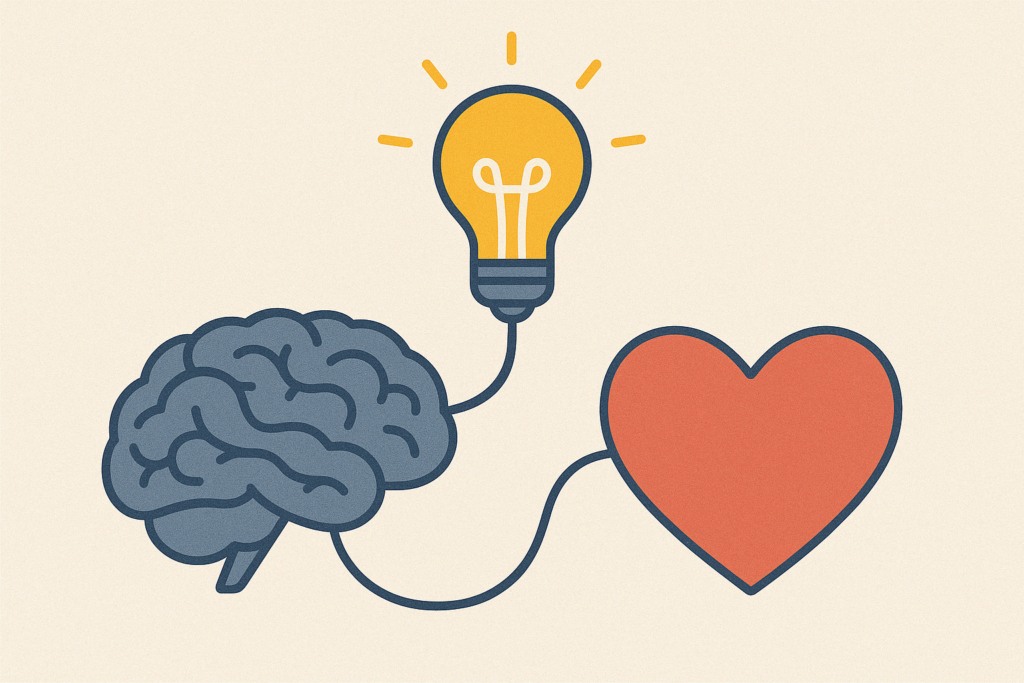
Visual Cue: AI-generated image using ChatGPT — A brain and heart are connected by a light bulb.
How Does Artificial Empathy Work and What are its Tools?
- Sentiment Analysis – determining emotional tone from text (e.g., “I’m fine” = possibly negative).
- Emotion Recognition – interpreting facial expressions, voice tone, or physiological data to guess emotion (Jee).
- Contextual Response – generating appropriate replies or actions (e.g., slowing voice tone if a user is angry).
Real-World Applications Across Industries
- Mental Health – chatbots offering emotional support.
- Customer Service – virtual assistants adjust the tone based on user frustration.
- Marketing – tailoring content based on emotional response.
The Process of Empathy
When empathy is often discussed, individuals think about it in terms of individuals feelings, reactions, and the internalization of emotional stimuli that we receive” (McStay). To assess empathy, it is vital to address the three parts that describe empathy to human beings.
- Cognitive empathy – The ability to understand another individual’s frame or reference.
- Affective empathy – The capacity for an individual to respond with an appropriate emotion.
- Somatic empathy – The physical reaction that is associated with the empathy processes.
A way to think about these three parts is when we feel another individual’s love for us; typically, the first part of empathy is cognitive empathy, which is to feel their love for us. Then, individuals will use their affective empathy to respond with our love for them. Finally, our love may lead to a physical reaction, for instance, one’s heart beating faster than usual, referred to as somatic empathy.
Empathy vs. Artificial Empathy: What’s the Fundamental Distinction?
Empathy, although essential for humans, is not so necessary to artificial intelligence, but it will be crucial in artificial intelligence systems if we want to move toward artificial general intelligence. “Just like human intelligence is different from artificial intelligence, artificial empathy is different from human empathy” (Wu). In the book Heartificial Empathy, Minter Dial describes artificial empathy as “the coding of empathy into machines” (Wu). Minter Dial delves into artificial empathy or artificial empathy as personal, situational, and based on the appropriate intentions. Although empathy can be learned about, artificial intelligence can be equipped with artificial empathy in the future. Yet, is it genuine? “Empathy is patiently and sincerely seeing the world through the other person’s eyes. It is not learned in school [but] cultivated over a lifetime.” – Minter Dial in Heartificial Empathy (Wu). It is now up to businesses to decide on the appropriate use cases of empathy to develop effective AI systems that will, in essence, add value to them. Minter Dial in Heartificial Empathy states, “The challenge will be finding the right mixture and chemistry for the agents to be assisted by machines in providing, in combination, a more empathic and effective service” (Wu). With the ability to identify appropriate cases of artificial empathy, businesses and organizations can implement more empathy into their services and employment.
Data Visualization
The Empathy Gap: How Tech Job Listings Reveal Shifts in Emotional Language
Description: Chart comparing aggressive vs. empathic language in tech job listings, showing established companies use more aggressive terms while newer ones use more empathic phrasing.
This data visualization compares empathic versus aggressive language use in job listings across significant tech companies from 2019 to 2021 (Violante). Established tech giants like Amazon, Google, and Microsoft returned to more aggressive phrasing—terms like “fast-paced” and “world-class”—by 2021, while newer tech companies such as Zoom, Airbnb, and Twitter leaned more heavily on empathic terms like “belonging” and “flexible.”
Based on an analysis of over 10,000 job listings by Textio, the chart illustrates a growing empathy gap in tech’s self-presentation (Violante). It highlights how language use reflects emotional alignment (or lack thereof) within corporate culture, especially in a post-pandemic landscape when emotional intelligence has become more valued.
Why This Matters?
This chart shows how language reflects emotional tone—and in the tech industry, that tone influences how AI systems are designed and trained. If companies prioritize aggressive over empathic communication, that same bias can appear in the datasets and values used to train AI systems to interact with humans. So, the chart isn’t just about job listings—it’s about the emotional modeling tech companies promote, which directly shapes the emotional intelligence (or lack thereof) in AI tools like chatbots, virtual assistants, and mental health apps (Jee). In short, If empathy isn’t modeled in real-world tech environments, we can’t expect AI to simulate it meaningfully.
Empathy in Practice: Case Studies in AI
Humans thrive on empathy and use emotions when speaking, thinking, and living. Emotions often have an impact on a large part of human intelligence. In 2012, a study by Aron K. Barbey et al., neuroscientists, confirmed that emotional intelligence and cognitive intelligence do, in fact, share many neural systems (Wu). This is shown when integrating cognitive, social, and affective processes. This study was able to confirm what “psychologists have suspected for decades: that there are interdependencies between emotional and general intelligence” (Wu). AI systems have become integrated into businesses and homes, taking over individuals’ livelihoods. What does this look like when discussing ethics? When human emotions and AI are meshed, some proponents suggest this is a “slippery slope.” In a way, the innate fear of enabling AI to one day displace humankind. Yet, our fear of this now singular entity is understandable and this scenario has not been encountered in our lives thus far.
Will AI’s ethics ever be superior to Human Beings?
For Artificial Intelligence to empathize with human emotions, it must be able to learn about the range of emotions we experience. In the article“Empathy in Artificial Intelligence” by Forbes, it states, “Emoshape is the first company to [have] patent technology for emotional synthesis. The emotion chip or EPU developed by Emoshape can enable any AI System to understand the range of emotions experienced by humans… the EPU can understand 64 trillion possible emotional states every 1/10th of a second” (Wu). This new range of emotions is governed and mapped onto a gradient where each emotion can be observed and studied to the maximum degree. Emoshape can also adapt to different scenarios while having a deeper situational awareness. With this rapid change, companies and individuals will have more empathy for how their businesses are run. This will enable growing enterprises to have core values that they hold as being humanistic and ethical.
Future Considerations and Ethical Dilemmas
Is AI “faking” empathy manipulative?
When AI systems simulate understanding and concern without truly experiencing emotions, what does it entail when a chatbot says, “I’m here for you,” but doesn’t understand what that means? Is it offering comfort—or performing an illusion?
How do we protect vulnerable users?
Emotionally aware AI may interact with users in distress—people experiencing loneliness, grief, or crisis. How do we ensure these systems don’t unintentionally exploit or mislead them? Should there be emotional consent or disclaimers about AI’s limitations?
What happens when emotional data is misread or even, misused?
AI trained to detect emotion can make mistakes. But even more concerning is when emotional data is collected and commodified: used in targeted advertising, hiring decisions, surveillance, or predictive policing. Emotional privacy, a concept rarely discussed, may become a vital right to protect (Jee).
Rethinking Empathy in the Digital Age
As individuals extend the invitation to emotionally intelligent systems into more intimate spaces—mental health apps, educational platforms, customer service—they must rethink empathy. Is it a feeling? A performance? A process of recognition? And, more importantly, is artificial empathy enough? Thoughtful regulation, transparency in handling emotional data, and a cultural shift in how we define meaningful connection. In a digital age, the connection may no longer depend on mutual understanding—but on careful design, ethical oversight, and a shared commitment to dignity in human-AI relationships.
Bibliography
“The ethics of artificial intelligence: Issues and initiatives.” European Parliament, http://europarl.europa.eu/RegData/etudes/STUD/2020/634452/EPRS_STU(2020)634452_EN.pdf. Accessed 2 February 2025.
Jee, Charlotte. “Emotion recognition technology should be banned, says an AI research institute.” MIT Technology Review, 13 December 2019, https://www.technologyreview.com/2019/12/13/131585/emotion-recognition-technology-should-be-banned-says-ai-research-institute/. Accessed 2 February 2025.
Kempe, Lena. “The Price of Emotion: Privacy, Manipulation, and Bias in Emotional AI.” American Bar Association, 9 September 2024, https://www.americanbar.org/groups/business_law/resources/business-law-today/2024-september/price-emotion-privacy-manipulation-bias-emotional-ai/. Accessed 2 February 2025.
McStay, Andrew. Emotional AI: The Rise of Empathic Media. SAGE Publications, 2018.
OpenAI. ChatGPT. 10 Apr. 2025, chat.openai.com/chat.
Robertson, Adi. “AI search engines are not your friends.” The Verge, 16 February 2023, https://www.theverge.com/23601763/bing-ai-search-guilt-trip-emotional-manipulation. Accessed 2 February 2025.
Ryan, Tate. “AI isn’t great at decoding human emotions. So why are regulators targeting the tech?” MIT Technology Review, 14 August 2023, https://www.technologyreview.com/2023/08/14/1077788/ai-decoding-human-emotions-target-for-regulators/. Accessed 2 February 2025.
Sahota, Neil. “AI And Emotion: Imagining A World Where Machines Feel.” Forbes, 22 January 2024, https://www.forbes.com/sites/neilsahota/2024/01/22/ai-and-emotion-imagining-a-world-where-machines-feel/. Accessed 2 February 2025.
Violante, Andrew. “Big tech and the big empathy gap.” Textio, 9 December 2021, https://textio.com/blog/big-tech-and-the-big-empathy-gap. Accessed 15 April 2025.
Wu, Jun. “Empathy in Artificial Intelligence.” Forbes, 17 December 2019, https://www.forbes.com/sites/cognitiveworld/2019/12/17/empathy-in-artificial-intelligence/. Accessed 1 April 2025.